Showing posts with label Marketers. Show all posts

Wednesday, September 7, 2011

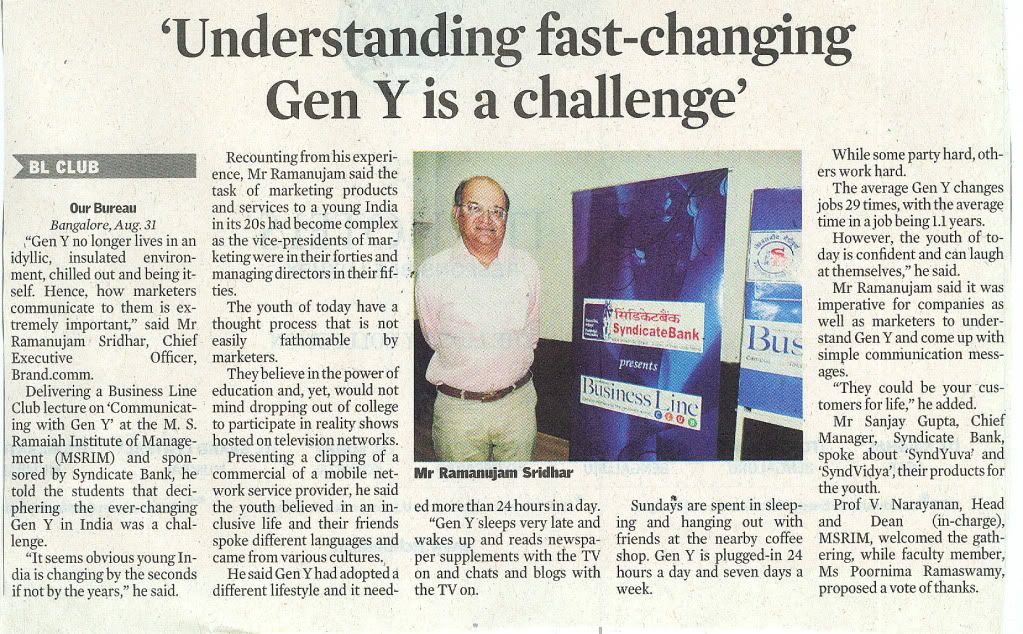
Understanding fast-changing Gen Y is a challenge

Gen Y no longer lives in an idyllic, insulated environment, chilled out and being itself. Hence, how marketers communicate to them is extremely important.

Photobucket

Ramanujam Sridhar CEO of brand-comm. and a Director of Custommerce.
Read my blog @ http://www.brand-comm.com/blog.html
Facebook: facebook.com/RamanujamSridhar
Twitter: twitter.com/RamanujamSri

Thursday, October 22, 2009

A tribute to print advertising

Our columnist makes a case for a return to the medium which, he says, allows marketers to “sell rationally”.

Vintage brand, vintage advertising.

When was the last time you saw a great print ad? I know I must scratch my head to get the answer, but given my failing memory and disappearing hairline, I may be excused. But what about you? One of my favourite pastimes is to ask people which adverti sing campaigns they remember. The answers vary from Cadbury’s (these are usually older people with diabetes who are not allowed to have chocolates), Fevicol (perhaps guys who have never fixed anything in their lives), Vodafone (definitely dog lovers married to people who cannot stand dogs), Idea Cellular (obviously guys who have never had a single idea in their lives), Tata Tea (guys who slept through election day) and Titan (perhaps because they have been gifted with so many watches in their lives).

These are seriously good television campaigns. But honestly, does anyone talk about press advertising today, much less remember it? And it is not as though we spend every waking moment in front of the idiot box. We surf the Net, spend half our working day sending forwards that no one reads, continue to read the newspaper in the loo (widely accepted as the best antidote to constipation) and browse through magazines (after all, we want to know who Salman is going around with). Yet, where are the ads that stop us? Ads with arresting headlines, visuals that paint a thousand words, body copy that is as easy to read as the topmost line in the optometrist’s chart and a tagline that is as easy to recall as the six times table (having a name like Ramanujam gives me some inherent numerical ability that sadly stops at this level of multiplication.)

Oh, the disadvantages of remembering the past!

I always wanted to be a copywriter. Maybe the advertising industry had earned some good karma, because I was never allowed anywhere near a typewriter. I returned with a vengeance and became a column writer, but that still does not explain my passion for copywriting. I was completely hooked on to ads. I lived, dreamt, ate and slept ads. And those ads were press ads. Who owned a television set in the Seventies?

I could visualise the pleasure of driving around in a Rolls Royce thanks to David Ogilvy’s much publicised lines “At sixty miles an hour the loudest noise in this new Rolls-Royce comes from the electric clock.” I still visualise the ride, as my books don’t sell a hundred million copies and I have only seen a Rolls Royce from the outside, most recently on the Bandra-Worli sea link. I was madly in love with the Volkswagen thanks to the “Think small” and the “Lemon” and the hundred other ads for the brand. Maybe one day I will buy a Volkswagen, who knows!
Who can forget the Avis “We try harder … ” ads? I was not a drinker when I saw the Cutty Sark ads that exhorted me to ‘never give up the ship’. If and when the brand is readily available in India I will follow that advice. I remember the Chivas Regal ad for Father’s Day and it still brings tears to my eyes when I read it: “Because I don’t say thank you as often as I should. Because it’s Father’s Day. Because if you don’t deserve Chivas Regal, who does?” says the ad. Clearly my children have not read the ad. In any case they studiously ignore the one day that poor, uncared-for fathers are recognised and blatantly ignore the most overt of reminders from their mother! They too will be fathers one day!

And what about the Absolut ads, arguably the greatest print campaign of all time! I can never forget the ‘Absolut DC’ ad with the bottle draped in oodles of red tape. Pity, the tape in New Delhi would have made that of Washington DC look a weak shade of pink without a shadow of doubt! Yes, those were romantic, heady days. We had some great press ads in India too with people such as Frank Simoes, Kersy Katrak, Kiran Nagarkar, Mohamed Khan, Elsie Nanji and Alok Nanda, to name just a few, who were doing great press work. Agencies such as Trikaya, Rediffusion, Enterprise, Ambience and Nexus produced print work that was comparable with the best in the world. But what happened after that?

Only TV, only TV, it’s only TV!

Even as Delhi struggles to get ready for the Commonwealth Games, it is worthwhile to remember that it was the Asiad in the same city that spawned the growth of colour televisions in the country and, therefore, TV advertising. Agencies realised the potency of this medium and geared themselves to meet the challenge. Many of the Levers brands such as Liril and Surf latched on to the medium. Other agencies, particularly Mudra (as I was familiar with its operations at that time), geared themselves to build competencies in this medium. Brands such as Vimal and Rasna walked into millions of living rooms with their creativity.

There was a point of view that talented film producers were bailing out agencies still trying to create for this medium as a lot of the early TV work was actually attributable to talented film producers who were improving the creative product enormously with their ideas and even their scripts. Be that as it may, agencies started to create for this medium and a new breed of copywriters emerged who understood and thrived in this medium. India has got enormous talent in Bollywood and Kollywood and every other ‘wood’.

The best names in films realised this was a different challenge – final products with a duration of 30 seconds as against three hours, needing its own brand of skills. This did not deter the best music composers, film and art directors from making their mark. It is pertinent to remember that A.R. Rahman started out as a jingle composer. Others such as P. C. Sreeram and Rajiv Menon from the South did outstanding work both in commercial cinema and in TV commercials. Consequently, our skills in this medium are finely-honed and over the years some outstanding work has taken place. When I visit the US and watch the TV commercials there, I am inclined to believe that the average TV commercial in India is much better conceptualised, produced and is a lot more rewarding for the viewer and there are billions. Yes, India has tremendous challenges of language, religion, customs, even dialects, but the advertising industry has conquered these in the medium of TV. But what about print?

So what is the problem?

As always, it is easier to describe the problem than to offer a solution, but problem definition is a good first step to finding a solution. The problem partly lies with the advertising agencies which have recruited, trained and rewarded a whole breed of copywriters who think, breathe and live TV scripts … and it shows. Success is built around the 30-second commercial and “integration” usually means one outstanding piece of work that is created for television and multiple adaptations of the same thought. The print version is usually a poor second cousin. Rarely is print the lead medium. Of course, the numbers justify the importance of the TV medium but print delivers brilliant numbers too, if only we recognise its value and functionality.

Print allows us to sell rationally. But do we have the skills? The old school of copywriters that I worked with was reared on Wren and Martin. (I can almost hear you asking who they are?) If they gave you a piece of writing, you could bet your bottom dollar that while you could argue about the creative approach, you could not utter a word about its correctness. They read The Hindu and The Statesman, did the crossword and could engage you intellectually. Of course, in those days ads were originally conceptualised, written and released in English and then translations followed. Today, the conceptualisation for most brands is created in Hindi. This is not necessarily a bad thing, but I wonder if that too is affecting the quality of the creative product as perhaps it is easier to create for TV in Hindi than to write ads in that language.

I think the time is right for the advertising agency to realise that it’s missing a trick. Television has been and perhaps will continue to be the low-hanging fruit. But there needs to be a long-term solution. The increasing literacy levels of the country and the potency of print as a medium cannot be ignored forever. I do know that agency folk listen more to their clients than to their spouses so maybe clients should put their foot down and ask for better print advertising.

Advertising too should highlight the value of print in its awards, forums and discussions. Maybe the newspaper industry should lead the way in this initiative. The industry has its own share of veterans who understand this medium and its nuances. Maybe now is the time to ensure that their talent is recognised. It is time for people like me who have been in the industry for ages to give back to the industry that has given us so much and what better way than to train the talented and yet raw youngsters who are in this industry and have no clue of what they should be doing?
Yes, the time is right to ‘Think Print’.

(Ramanujam Sridhar is CEO, brand-comm, and the author of Googly: Branding on Indian Turf.)
Thursday, February 26, 2009

Brand sceptics?

Ramanujam Sridhar

India is still romancing with brands but the end of the honeymoon period is near..
The task of marketing to this multi-tasking, multi-asking generation is simultaneously a challenge and an opportunity.

A few weeks ago I was invited to Mumbai to be one of the panellists in a seminar on customer loyalty. Between you and me, a “loyal customer” is something of an oxymoron, just as the descriptions “faithful husband” or “well-behaved teenager” can be! Instead of waxing eloquent on the frailties of the human race, let me move on to the topic of discussion of our particular panel, which was on “defining the customer of the future”. I shared the panel with a few people who were wiser if not older than me — Kinjal Medh, Chief Operating Officer, Cogito Consulting; Arvind Sharma, Chief Executive Officer and Chairman, Leo Burnett; Rajiv Lal, Chief Executive Officer Perspectrum; and Satish Sathyanarayana, Chief Executive Officer, Wunderman India Pvt Ltd. Here is a smattering of predictions on the future customer made by this eminent group. Needless to mention that the original and pathbreaking predictions were made by the other esteemed panel members, whilst I attempted to provide comic relief to a post-lunch seminar audience that had been fed on an overdose of dessert and a numbing mix of matrices and statistical mumbo jumbo earlier in the day.Worry, worry, worry

As a starting point it might be worthwhile to remember what Mike Clasper, the former President of Procter and Gamble, said, “I would label the consumer of 2025 in three ways: more demanding, wiser and more worried.” Well, I guess, we don’t have to wait another 16 years to check the validity of this prediction because it seems to have already come true today. Aren’t we more demanding today than we were five years ago? I can speak for myself and say that I have certainly become a lot more demanding as a customer. Just ask Airtel or Standard Chartered Bank. And if the doorman at the Taj does not come springing to open my car door, I am frowning at his lethargy and waxing eloquent about the poor service of the five-star hotel to the total disinterest of my family!

Of course, if you ask my wife she would go a step further and say I have graduated from merely being demanding to becoming more of a pain. But then spouses, they say, cannot be objective about their partners, so much do they love them! I guess consumers are certainly becoming more knowledgeable, if not wiser, though the increasing speed of the decreasing hair line of today’s generation is definitely to be viewed as a sign of wisdom! They have certainly become more worried as this generation has been through more crises than any other and even the strongest of minds would be worried after what happened in Mumbai.

So, what it does it mean for marketers? There is a crying need to go back to the old fashioned and yet-still-relevant quality of ‘empathy’ that salespeople needed then and need more than ever now, and will need in the future too. I need empathy from service providers, harried as I am now by the uncertainty in the global environment, crashing value of investments, plummeting real estate prices and the general mood of depression that has engulfed the world, Obama notwithstanding.Why can’t you be like her?


Human beings love to compare. We all know that and customers, after all, are human beings. The reality, however, is that too few service providers (in India at least) are providing exceptional service. Speaking of airlines, I have some familiarity with, if not affinity for, Jet and Kingfisher in the premium category and recently Indigo in the budget category that are providing superior service. I have always been a great admirer of Jet Airways and speak passionately for them at every forum. And yet, I have a distressing habit as well. When I go to the nationalised bank, which holds my savings bank account (with a modest balance if I may add) I expect the person in the counter to be smart, friendly and vivacious, just like the stewardess who ushers me into the Jet Airways flight. Sadly for me, though, she is grumpy, harassed and probably sees shades of her spouse in me, so severely does she scowl at me! I know that I am being unreasonable in expecting her to be like the Jet Airways stewardess but then “I am like that only”. I can safely predict that trends like these are here to stay, and if anything is likely to intensify tomorrow as more and more of tomorrow’s customers will make odious comparisons across categories and find their service providers wanting.


There is another distressing trend with service providers and that includes me as well. It is that we have one set of benchmarks for ourselves when we are customers and a different set when we provide services to customers. No prizes for guessing which is lower! Marketers need to completely change their outlook on service and the consumer today, if they want to survive tomorrow.Multi-tasking, multi-asking.

My marketing teacher at IIM Bangalore proffesor P.N. Thirunarayana, who instilled and fuelled my desire to be in marketing, called India’s young generation as the MTV generation, whom he defined as multi-tasking, time-compressed and value-seekers. Yes, India is a young country with an overwhelming proportion of youngsters who are in their twenties. The reality, however, is that while Indian consumers are in their twenties, heads of marketing are in their forties and managing directors are in their fifties. Needless to say, the politicians who run this country are in their eighties! How do we cope with this techno-savvy young customer who is simultaneously watching TV on mute, listening to music on her iPod, even as she is frantically punching the keys of her mobile phone to send numerous text messages by the minute to scores of her friends? I am told that today’s youth can exhaust the quota of 750 free SMS messages per day by 9 a.m! We are just seeing the tip of the iceberg as India’s youth brigade explodes not only in size but in affluence. The task of marketing to this multi-tasking, multi-asking generation is simultaneously a challenge and an opportunity. How many marketers are going to be equal to the challenge? Only time will tell!

There is another new dimension to the Indian economy that the future might unfold and that is the ‘baby boomers’ who are currently in their fifties and they represent another potent market segment. They are the “in between generation” — caught between tipples of scotch and snatches of Bhagavad Gita. They have hefty wallets (and matching waistlines) and yet are largely ignored by marketers despite their high net worth. To give you an example, whilst I got so many birthday wishes from the Shoppers Stops and the Stancharts of this world, no one sends me specific offers considering my age or lifestyle! So marketers are clearly not using the information that they have optimally. So we have two strong and yet diverse target segments that can and must co-exist for the benefit of the marketer, however diverse they may be in terms of demographics and psychographics. But then who said marketing is easy?


Now let’s go back to the generation that is going to rule India. How do we get and hold the attention of today’s and tomorrow’s customer who has the attention span of a nano second? How do we engage her, despite the multitude of distractions that seem such an inherent part of modern, urban life? Don’t lecture to this audience. They do not need one more teacher. Surprise them at a time when they least expect it. Have a tone of voice that is engaging. What made KBC such a big hit when it was first launched? There was Amitabh, whom the young audience could rely on, who was friendly, helpful and empathetic. Let’s not forget that many youngsters who were hooked on to it were the latchkey generation that lived in nuclear homes, where both parents were working. Brands will have to become friendlier even as their consumers get flightier. Brands will need to win the battle for share of mind, a far cry from the days when brands were obsessed with share of shelf.Romantic or sceptic

Today, India is still romancing with brands. We are still in our honeymoon period, so to speak. And yet one can see that customers like me are getting disenchanted with our wooers, who call us at odd times of the day, like 3 p.m. on a Sunday afternoon! We are annoyed and irritated with marketers who ignore the fact that our number is a “do not call number”. Our patience is currently running thin, but I am not sure if the people who are wooing us are aware of that just yet. It will not be long before we become brand sceptics though and that is something that marketers should be well aware of. Brand romantic or brand sceptic? Only time will tell.

(Ramanujam Sridhar is CEO, brand-comm, and the author of One Land, One Billion Minds.)